

Products
Fast, Reliable, Everywhere

Solutions
Efficient, Innovative EV Charging Solutions.
News
We are committed to the innovation and application of EV charging.





Most charging cabinets earn only when a vehicle is plugged in. This one earns even when no car is present. By combining DC fast charging with a 32-inch digital advertising display, you add a second profit center—high-visibility media—without adding a second footprint. It’s a smarter way for site operators and property owners to grow revenue per parking bay while delivering a better driver experience.
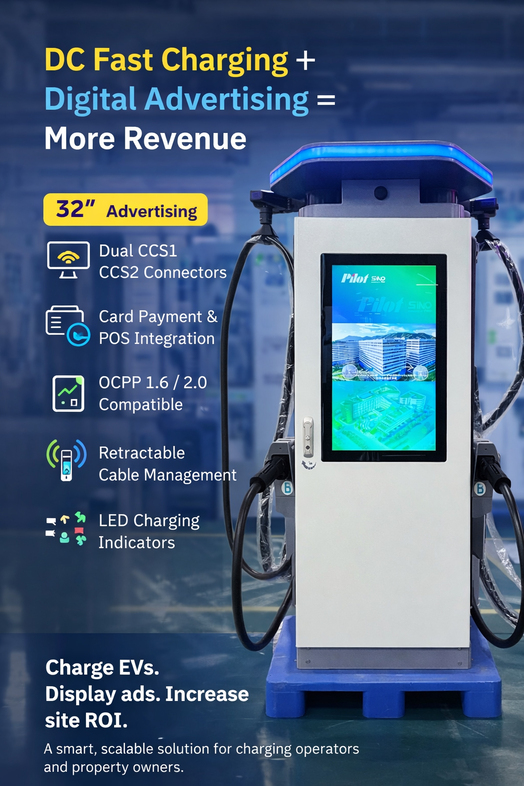
32" advertising display built into the front panel for DOOH (digital out-of-home) campaigns, brand storytelling, and on-site cross-promotion.
Dual CCS1 / CCS2 connectors to serve mixed vehicle standards across markets.
Card payment & POS integration so walk-up drivers pay as they would at retail—tap, chip, or swipe.
OCPP 1.6 / 2.0 compatible, giving you freedom to select and switch networks, use open roaming, and centralize monitoring.
Retractable cable management that keeps cables off the ground, reduces wear, and improves accessibility.
LED charging indicators with clear status at a distance for faster lane turnover and easier bay management.
1) Energy sales (DC fast)
Serve quick-turn customers and fleets with high power, high uptime, and predictable session times.
Take payment on the spot via POS or authenticated accounts; implement idle fees to improve bay availability.
Use OCPP-based analytics to track utilization, average session length, and delivered kWh—then tune pricing by time of day.
2) Digital advertising (32" display)
Run programmed loops: brand ads, local merchant offers, sponsor takeovers, public service messages, or your own loyalty promotions.
Daypart content by traffic pattern (morning commute vs. evening retail).
Cross-sell on-site tenants (coffee, convenience store, grocery) to lift basket size while drivers wait.
Together, these streams stabilize cash flow: when utilization is low, the screen still monetizes footfall and impressions; when utilization is high, you monetize both the energy and the audience.
High-intent audience. Charging customers are already on site and attentive to the interface and the screen.
Measurable dwell. Sessions create natural 10–30 minute windows for promotions and call-to-action messaging.
Retail synergy. Place chargers near entrances to move drivers past storefronts while the screen advertises time-sensitive deals.
Open protocol (OCPP 1.6 / 2.0). Avoid vendor lock-in, integrate with your preferred CPO platform, and enable third-party roaming.
POS + contactless. Reduce abandoned sessions with familiar retail payment flows; support receipts and dispute resolution.
Remote fleet tools. Firmware updates, alarms, and fault diagnostics reduce truck rolls; thin client advertising CMS lets your marketing team schedule content without touching the charger firmware.
Safety & accessibility. Retractable cables reduce tripping hazards; LED indicators communicate status instantly; large UI and screen height support easier reach.
Retail & mixed-use: Supermarkets, malls, QSR drive-ups—tie promotions to time-of-day traffic.
Fuel & convenience: Convert forecourt footfall into kWh sales and on-screen upsells.
Hospitality & venues: Hotels, arenas, and destinations benefit from on-premise upsell (F&B, tickets, services).
Municipal & campus: Promote public messages while supporting equitable access to fast charging.
Fleet & ride-hailing hubs: Show driver instructions, safety notices, and sponsor content during dwell.
Annual charging margin = (Price per kWh − Delivered cost per kWh) × Annual kWh sold
Annual media revenue = Booked ad slots per year × Net CPM/flat-rate after agency fees
Annual O&M = Networking + payment processing + maintenance + content ops
Payback (years) = Total capex ÷ (Annual charging margin + Annual media revenue − Annual O&M)
Optimization tips:
Increase media yield with location-based pricing (entrance-adjacent bays command a premium).
Raise energy revenue by improving uptime, bay turnover, and signage; dynamic pricing during peaks smooths queues.
Reduce costs by clustering cabinets near switchgear (shorter trench), using shared raceways, and negotiating utility make-ready early.
Select sites by audience & power: pair high-visibility retail entrances with the right kW class for expected dwell.
Coordinate utility & permits: confirm service point, transformer plan, ADA routes, and signage placements in writing.
Finalize POS & network stack: choose a CPO backend and payment processor; map OCPP objects, receipts, and reporting.
Install with cable management and sightlines in mind: protect approach angles, keep cables off the ground, preserve working clearances.
Commission charging first, then content: run load tests and payment flows; next, push a 7–15-second ad loop and verify daypart schedules.
Measure & iterate: weekly utilization and ad-fill reports; adjust pricing, content mix, and bay numbering to reduce friction.
Display: 32" integrated advertising panel, daylight-readable; content managed via CMS with scheduling and playlists
Connectors: Dual CCS1 / CCS2 (regional configuration)
Payments: Card present (tap/chip/swipe) + POS integration; optional account/RFID
Protocol: OCPP 1.6 / 2.0 compatible; remote monitoring and firmware updates
Cable management: Retractable system; extended reach for front/left/right inlets
User cues: LED charging indicators visible at distance; large UI for quick start/stop
Higher revenue density: one bay delivers kWh margin + ad income.
Tenant uplift: display promotes on-site tenants in rotation.
Future-proof: open protocols and modular media make refresh cycles straightforward.
Better customer experience: clean cables, fast sessions, clear status—drivers return.
Charge EVs. Display ads. Increase site ROI.
This integrated DC fast charger turns a necessary utility into a powerful media touchpoint. For operators who care about utilization, uptime, and brand equity, it’s the simplest way to make each square meter of your property work harder—without sacrificing user experience or network flexibility.
Use the 32" front panel for welcome screens, QR-based loyalty, time-of-day promos, and public service messages.
Pair the on-charger message with parking lot totems and app notifications for a complete journey: arrival → charge → shop → return.
If you’d like, I can adapt this copy for a landing page (hero, features grid, ROI calculator module, FAQ) or condense it into a one-page PDF brochure with visuals and a simple payback worksheet.