


Products
Fast, Reliable, Everywhere


Solutions
Efficient, Innovative EV Charging Solutions.
News
We are committed to the innovation and application of EV charging.




If you’re planning an EV site, “How much will it really cost?” is the first question—and the hardest to answer without a structured method. Below is a deep, practical guide that breaks costs into clear components, gives realistic USD ranges by power level and scenario, and ends with a copy-ready calculator and checklists. (No external links; numbers are planning bands before tax and incentives.)

| Charger class | Typical hardware | Typical install & make-ready | Typical all-in |
|---|---|---|---|
| Level 2 (AC) | $2,500–$6,000 | $2,000–$6,000 | $6,000–$15,000 |
| DC Fast ~50 kW | $35,000–$70,000 | $25,000–$60,000 | $75,000–$150,000 |
| DC Fast 120–180 kW | $55,000–$110,000 | $45,000–$100,000 | $125,000–$220,000 |
| DC Fast 300–350 kW | $90,000–$160,000 | $70,000–$120,000 | $180,000–$300,000+ |
Sanity check for a corridor site: A four-connector location at ~150 kW each commonly totals about $0.8–$1.1 million all-in, depending on utility scope and civil works.
Hardware – dispensers, pedestals/wall mounts, cable management, payment terminal, networking module, and (for DC) rectifier cabinets.
Installation & civil – trenching/boring, conduits and wire, switchgear and panels, pads, bollards, striping, signage, lighting, and commissioning.
Utility make-ready – new service, transformer upgrades, metering; the biggest wild card for DC fast.
Soft costs – surveys, design & engineering, permits, inspections, project management, as-builts.
(Ongoing costs—maintenance, networking, payment processing, electricity/demand charges, SLAs—are operational, not capex, but you should budget them early.)
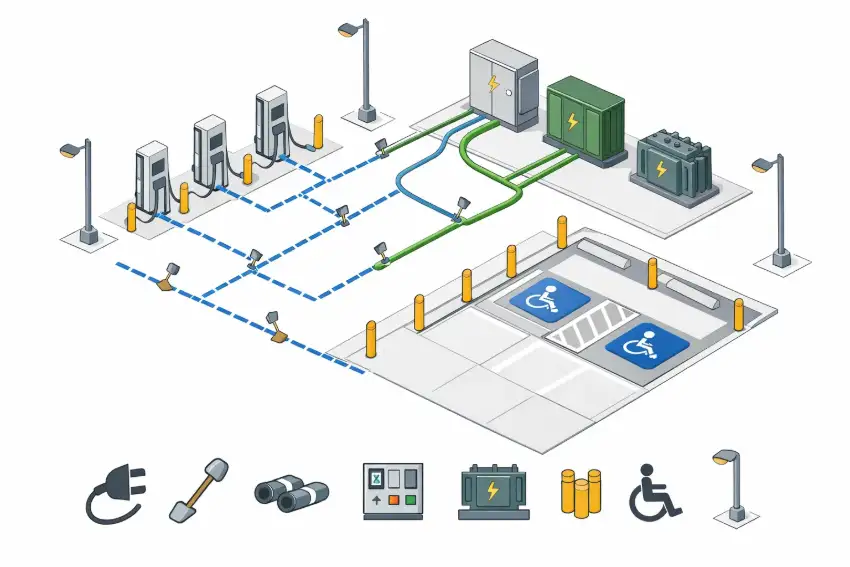
Power level: Higher kW raises dispenser cost and everything behind it (larger conductors, switchgear, liquid-cooled cables at 300–350 kW).
Trenching geometry: Long cross-lot runs, saw-cutting, or utility conflicts can double installation. Clustering pedestals and using wall-mounts cut cost.
Utility distance/capacity: Three-phase capacity near stalls keeps costs moderate; long service runs or new transformers add five- to six-figure line items and months of lead time.
Site standards: Canopies, premium lighting, dual-cable dispensers, contactless payments, revenue-grade metering, and branded totems improve UX and uptime but add capex.
Scale effects: Per-connector cost drops as port count increases (mobilization, trenching, and design are shared).
Jurisdiction & schedule: Urban cores and multi-agency permits push soft costs higher; plan contingency.
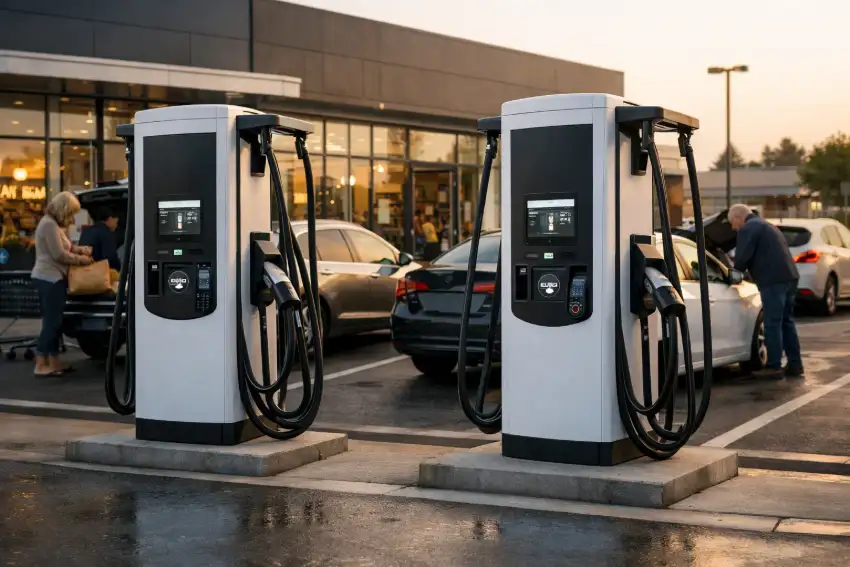
All figures are USD planning bands before tax/incentives. Use them to frame budgets, then refine with local quotes.
Hardware: $20,000–$48,000
Install & make-ready: $16,000–$48,000 (short runs → low end; new lighting/ADA concrete → high end)
Soft costs (15–20%): $5,400–$19,200
Total: $41,000–$115,000
Notes: Wall-mounting and shared raceways often pull this toward $50k–$80k. Great for offices, hotels, and destinations.
Hardware: $110,000–$220,000
Install & make-ready: $90,000–$200,000
Soft costs (15–20%): $30,000–$84,000
Total: $250,000–$500,000
Notes: Distance to service point and switchgear upgrades dominate variance.
Hardware: $220,000–$440,000
Install & make-ready: $300,000–$520,000 (pads, canopy, long trenching, possible transformer)
Soft costs (15–20%): $80,000–$196,000
Total: ≈ $0.8–$1.1 million
Notes: Design for future lanes; oversize conduits and spare breaker space now.
Hardware: $330,000–$660,000
Install & make-ready: $270,000–$600,000
Soft costs (15–20%): $90,000–$252,000
Optional BESS 500 kWh (containerized): $300,000–$500,000
Total: $0.99–$2.01 million (without/with storage)
Notes: Storage smooths peaks, accelerates go-live when utility upgrades lag, and hedges demand charges.
L2 hardware/install: $72,000–$180,000
DC hardware/install: $200,000–$420,000
Soft costs (15–20%): $41,000–$120,000
Total: $313,000–$720,000
Notes: Balanced portfolio: L2 covers long-dwell shoppers; DC captures quick-turn traffic.
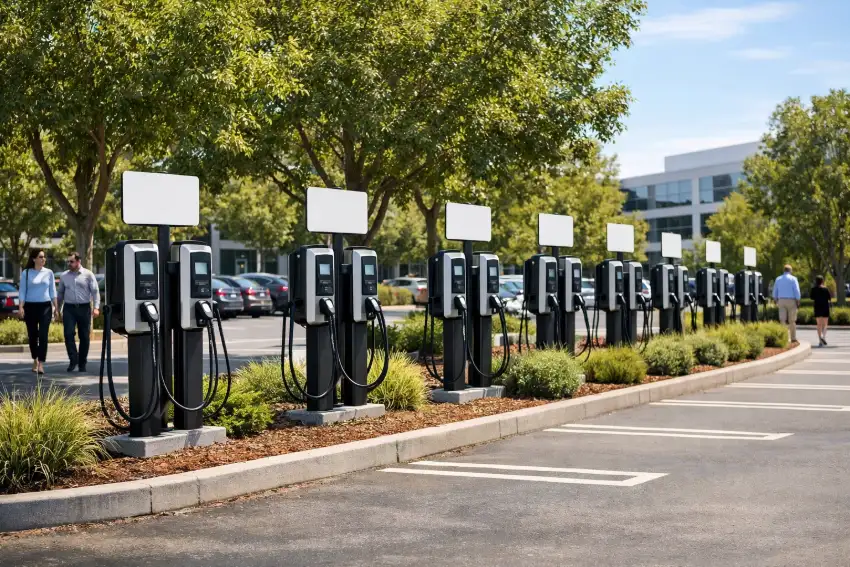
Paste this block into your spreadsheet and adjust the band you choose per line.
A) Hardware per connector
L2: 2,500–6,000
DC 50 kW: 35,000–70,000
DC 120–180 kW: 55,000–110,000
DC 300–350 kW: 90,000–160,000
B) Install & make-ready per connector
L2: 2,000–6,000
DC 50 kW: 25,000–60,000
DC 120–180 kW: 45,000–100,000
DC 300–350 kW: 70,000–120,000
C) Soft costs & contingency
Start at 15% × (A + B); use 20–25% for complex sites or uncertain utility scope.
All-in cost per connector = A + B + C
Site check: 4×150 kW all-in should circle $0.8–$1.1M.
Feasibility & utility pre-check (2–6 weeks): load study, service point, lead times.
Concept & permits (4–12 weeks): layout, one-line, civil plans, ADA review.
Procurement (6–20 weeks): long-lead gear (transformer, switchgear, high-power dispensers).
Civil & electrical works (3–10 weeks): trenching, pads, gear set, pulls/terminations.
Commissioning (1–3 weeks): network config, payment tests, safety and metering checks.
Parallel: branding, signage, mapping listings, and SLA contracting.
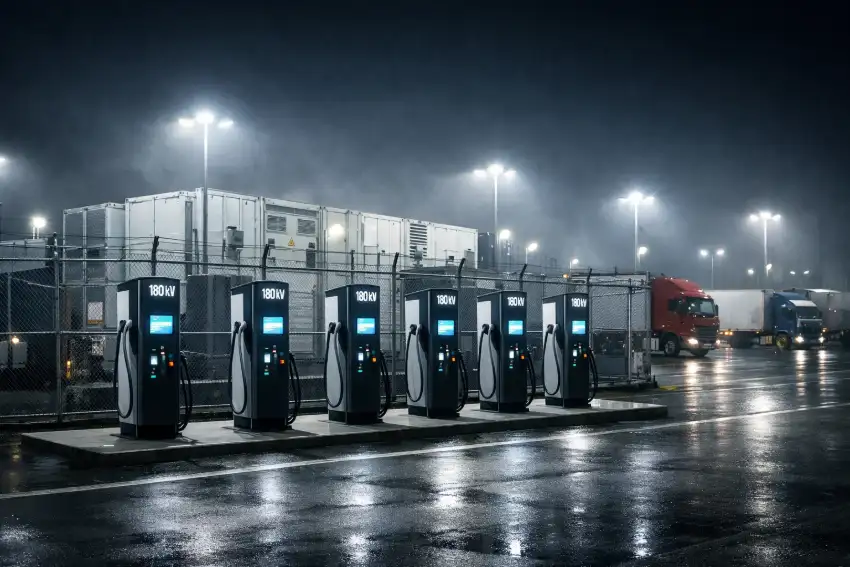
Match power to dwell time: if average stay is 20–40 minutes, 120–180 kW often suffices.
Shorten trenches: keep dispensers close to service gear; share raceways.
Wall-mount Level-2 where possible: pedestals cost more civil work.
Standardize drawings: reuse detail sheets to lower soft costs.
Bundle scope (design-build/EPC): fewer change orders and better schedule control.
Future-proof cheaply: oversize conduits and pads; stub to future pedestals.
Choose dual-cable DC dispensers: higher unit price, better compatibility and throughput.
Specify open protocols & remote diagnostics: reduce truck rolls and vendor lock-in.
Coordinate utility first: written confirmation of capacity and metering requirements.
Phase builds: pull fiber/power for the end state; populate dispensers as demand grows.
Maintenance & extended warranty: annual line item per charger for inspections, consumables, and spares; schedule connector/cable refresh at known wear intervals.
Networking & payment processing: per-charger annual fees plus transaction costs; enables remote fixes and accurate settlement.
Electricity & demand charges: delivered cost depends on tariff and utilization; storage, power-sharing, and scheduled caps help.
Uptime SLAs: set availability targets and mean-time-to-repair that match your revenue goals.
Power class & port count defined; growth path documented
Utility capacity, service point, and metering approach confirmed in writing
Layout minimizes trenching; ADA and traffic flow verified
Switchgear one-line with spare capacity and future conduits
Open protocol chargers; remote diagnostics and firmware updates
Payment stack: contactless, chip, app/RFID; revenue-grade metering
Lighting, wayfinding, stall numbering, and emergency shutoff locations
Preventive maintenance plan, spares list, and SLA response times
Commissioning test plan; as-builts, O&M manuals, and training

Is Level-2 enough for commercial?
For long-dwell sites (offices, hotels), yes. Pair Level-2 volume with a small number of DC ports for fast turns.
Biggest cause of budget overruns?
Underestimating utility make-ready and long trench runs. Engage the utility first.
Can storage lower cost?
Yes—storage can cap peaks, speed go-live where capacity is tight, and support backup modes. Model it against tariff and utilization.
How fast can I scale later?
If you oversize conduits, leave spare breaker space, and standardize foundations now, adding ports is quick and cheap.
Treat cost as Hardware + Installation/Make-ready + Soft Costs, then sanity-check by power class and scenario. Design for future scale, coordinate utilities early, and standardize drawings and gear. Do this, and your “budget” turns into a buildable plan—without surprises.