

Products
Fast, Reliable, Everywhere

Solutions
Efficient, Innovative EV Charging Solutions.
News
We are committed to the innovation and application of EV charging.





Fast DC charging with built-in 208.9 kWh battery, V2G-ready control, and smart O&M—engineered for uptime and ROI
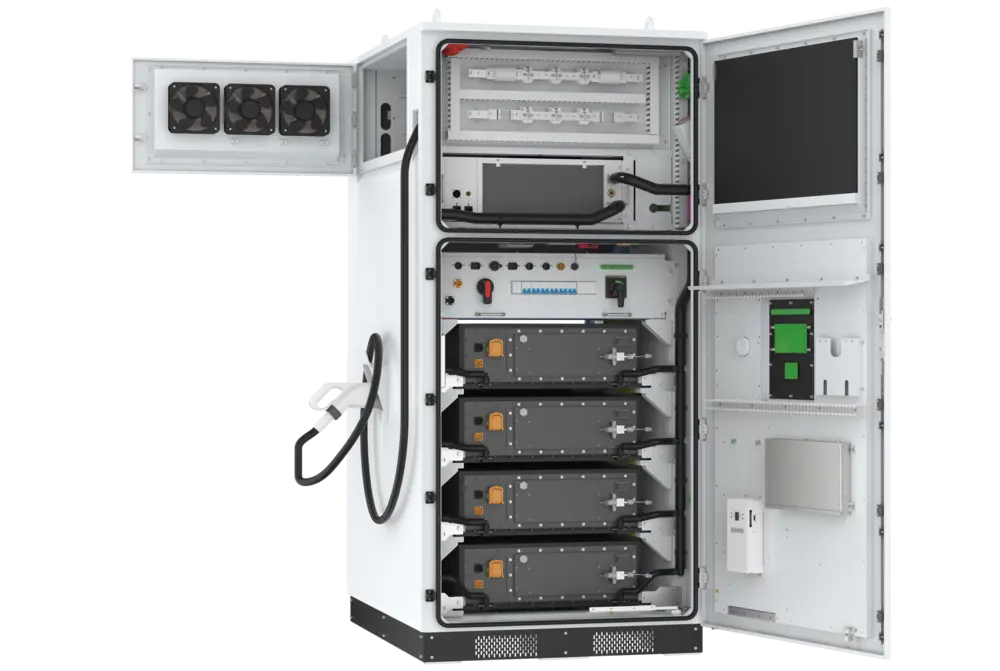
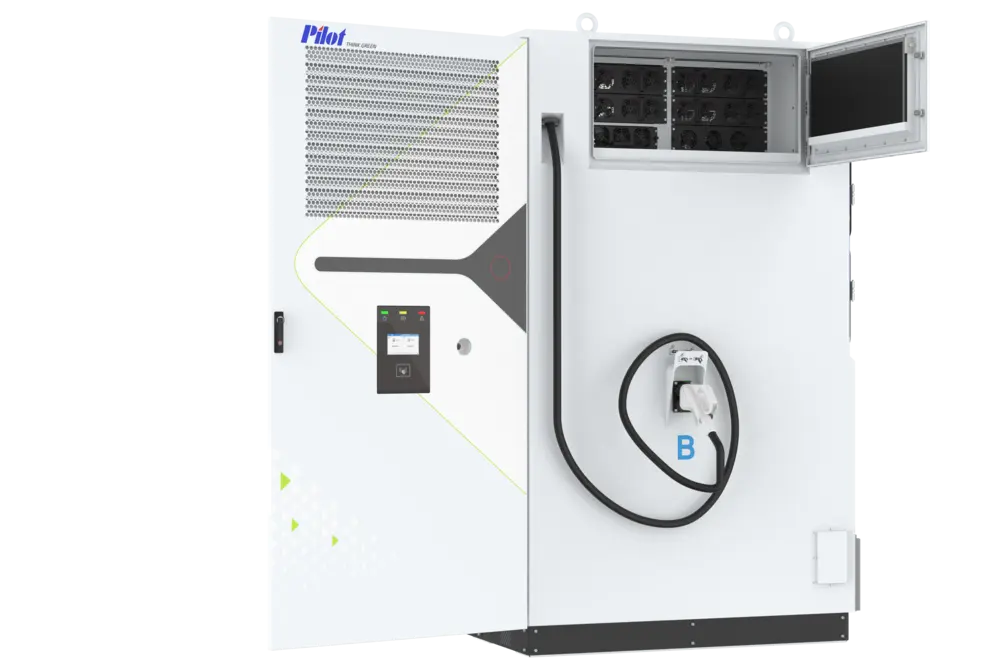
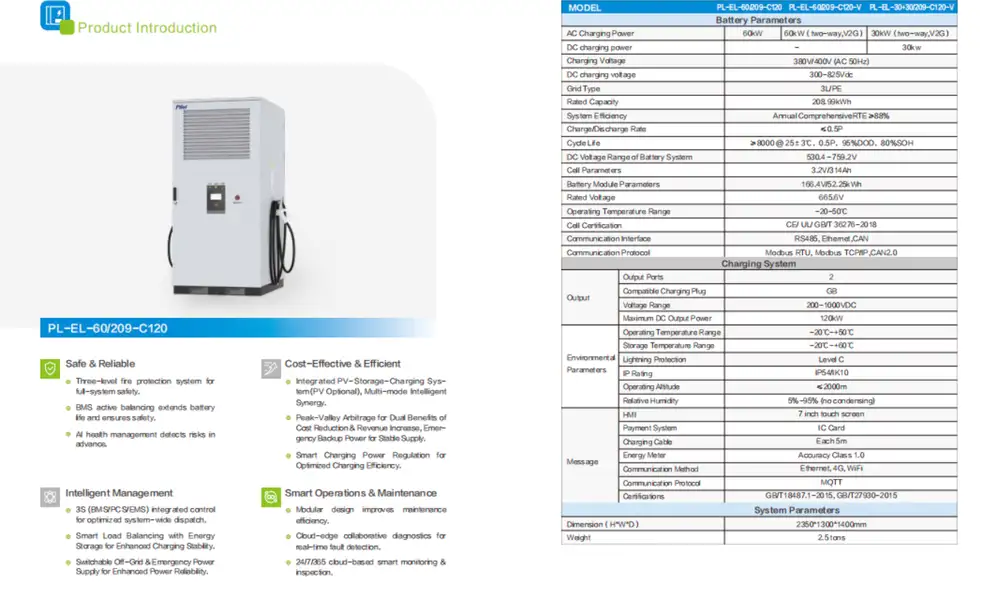
As EV sites scale, the limits of the grid show up first: high demand charges, transformer bottlenecks, and costly upgrades. Pilot’s PL-EL Series solves that problem at the cabinet—combining a high-efficiency energy storage system (≈208.9 kWh) with a DC fast charger up to 120 kW output and optional AC 60 kW interface in one rugged enclosure. The result is a compact, utility-friendly “power plant in a box” that delivers fast charging today while preparing your site for tomorrow’s energy models.
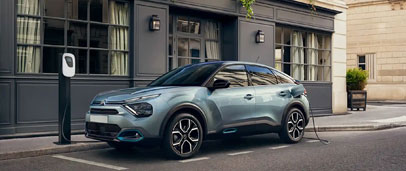
1) Charge more cars without waiting for a bigger grid.
The integrated battery buffers peak loads and shares power intelligently with the charger. You can add high-value fast-charging bays now, keep queues short at rush hour, and avoid (or defer) transformer upgrades. With 200–1000 V DC output and dual ports (GB standard), the PL-EL fits modern EV packs and supports simultaneous sessions with dynamic power allocation.
2) Slash demand charges and stabilize energy costs.
Charge the battery during off-peak windows and discharge during peaks to shave the kW spikes that drive utility bills. Built-in logic supports peak-valley arbitrage and smart power regulation, so each kWh sold contributes more margin. Pair with on-site PV to capture midday solar and deliver clean, low-cost energy when drivers arrive.
3) Designed for real-world reliability.
A three-level protection system plus active BMS balancing protect cells and electronics, while health management detects risks early. The battery uses long-life LFP cells (3.2 V / 341 Ah) with a tested cycle life ≥ 8000 @25 °C, 0.5 P, 95 % DOD, 80 % SOH, and an annual comprehensive round-trip efficiency ≥ 88 %. The cabinet is built for outdoor duty with IP54 / IK10 protection (as configured), lightning protection, and an operating range of -20 °C to 50 °C.
4) Lower OPEX with modular design and remote ops.
Hot-swap power modules, front access, and clear diagnostics shorten maintenance windows. Remote monitoring (Ethernet/4G/Wi-Fi) and OCPP/MQTT/Modbus/CAN communications enable OTA updates, pricing changes, and fleet rules without a truck roll. Accurate Class 1.0 metering, 7-inch touch HMI, and IC-card payment keep on-site workflows simple.
5) Bidirectional by design.
Select models support two-way DC / V2G functionality (regional regulations apply), enabling future programs for grid services, fleet energy return, or site-level microgrid modes.
Battery energy: ≈208.9 kWh (LFP)
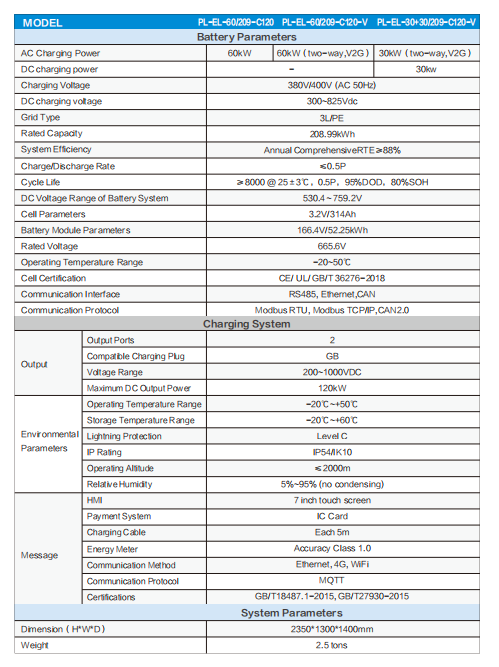
DC fast charge output: up to 120 kW, 200–1000 V DC
AC interface (select models): 60 kW
Battery voltage window: ≈530–759 V; rated ≈655 V
Charge/discharge rate: ≤0.5 P
Operating temperature: -20 °C to 50 °C (storage to 60 °C)
Ingress/mechanical: IP54 / IK10 (typical), lightning protection
Interfaces & protocols: RS485, Ethernet, CAN; Modbus RTU/TCP, CAN 2.0, MQTT
Comms: 4G, Wi-Fi, Ethernet
HMI & payment: 7-inch touch screen, IC card; dual 5 m DC cables
Standards (typical): GB/T 18487.1-2015, GB/T 27930-2015; cell/battery certifications per CE/UL/GB/T 36276-2018 (model dependent)
Cabinet footprint: about 2350 × 1300 × 1400 mm, ≈2.5 t
(Specifications may vary by model: PL-EL-60/209-C120, PL-EL-60/209-C120-V, PL-EL-30/30/209-C120-V, etc. Connector standards and certifications differ by region.)
Peak-shaving & time-shifting:
Charge the battery overnight or midday (with PV), then discharge to supply fast charging during costly peak windows. This reduces both demand charges and energy costs per kWh sold.
Build once, scale smart:
A single integrated cabinet is faster to permit and install than a separate BESS + charger + switchgear stack. As utilization grows, add more dispensers or cabinets and orchestrate them through your charge-point management system.
Resilience & backup power:
In grid disruptions, the system can provide emergency backup for critical loads (site configuration required), helping you keep minimal operations or evacuation charging online.
Better driver experience:
High, stable power and clear HMI prompts shorten dwell time and cut support calls. Dual-side holsters and 5 m cables reach ports easily; status lights and messaging reduce uncertainty at the bay.
Highway/travel centers where peak demand surges would otherwise overwhelm the grid
Urban retail & hospitality that want fast charging without transformer upgrades
Fleet depots & logistics yards needing predictable turnaround time and resilient power
Industrial parks & campuses integrating PV for greener, lower-cost energy
Remote or constrained grids where microgrid operation and backup are essential
Pilot’s engineering prioritizes layered protection: BMS-driven cell monitoring, insulation and ground-fault detection, temperature and smoke sensors, and clearly placed emergency stop. The system architecture supports region-specific compliance and certification paths; our applications team provides drawings, grid interconnection guidance, and commissioning support to accelerate approvals.
Bring us your load profile, tariff, and site drawings. We’ll size the battery and charging power, estimate demand-charge savings, and map a deployment plan that meets your ROI targets—whether you’re upgrading a single forecourt or rolling out a city-wide network.
Pilot PL-EL Integrated PV-Storage-Charging System:
Fast charging that respects the grid, lowers your energy bill, and keeps drivers moving—today and for years to come.